TAURUM Technologies

True Innovation

  •  The Invention
  •  The Patents 
    • · Patent Family
    • · Ownership
    • · Drawings
    • · Excerpts
    • · About patents
  •  The Company 
    • · Key Milestones
    • · Videos
    • · Parenting company
    • · Talent Force
    • · Advisory Board
  •  React
  •  
  •     THUMBRAY
  •  The Invention
  •  The Patents
    • Patent Family
    • Ownership
    • Drawings
    • Excerpts
    • About patents
  •  The Company
    • Key milestones
    • Videos
    • Parenting company
    • Talent Force
    • Advisory Board
  •  React

Skin-Touching Electromagnetic Sensing WEARABLE

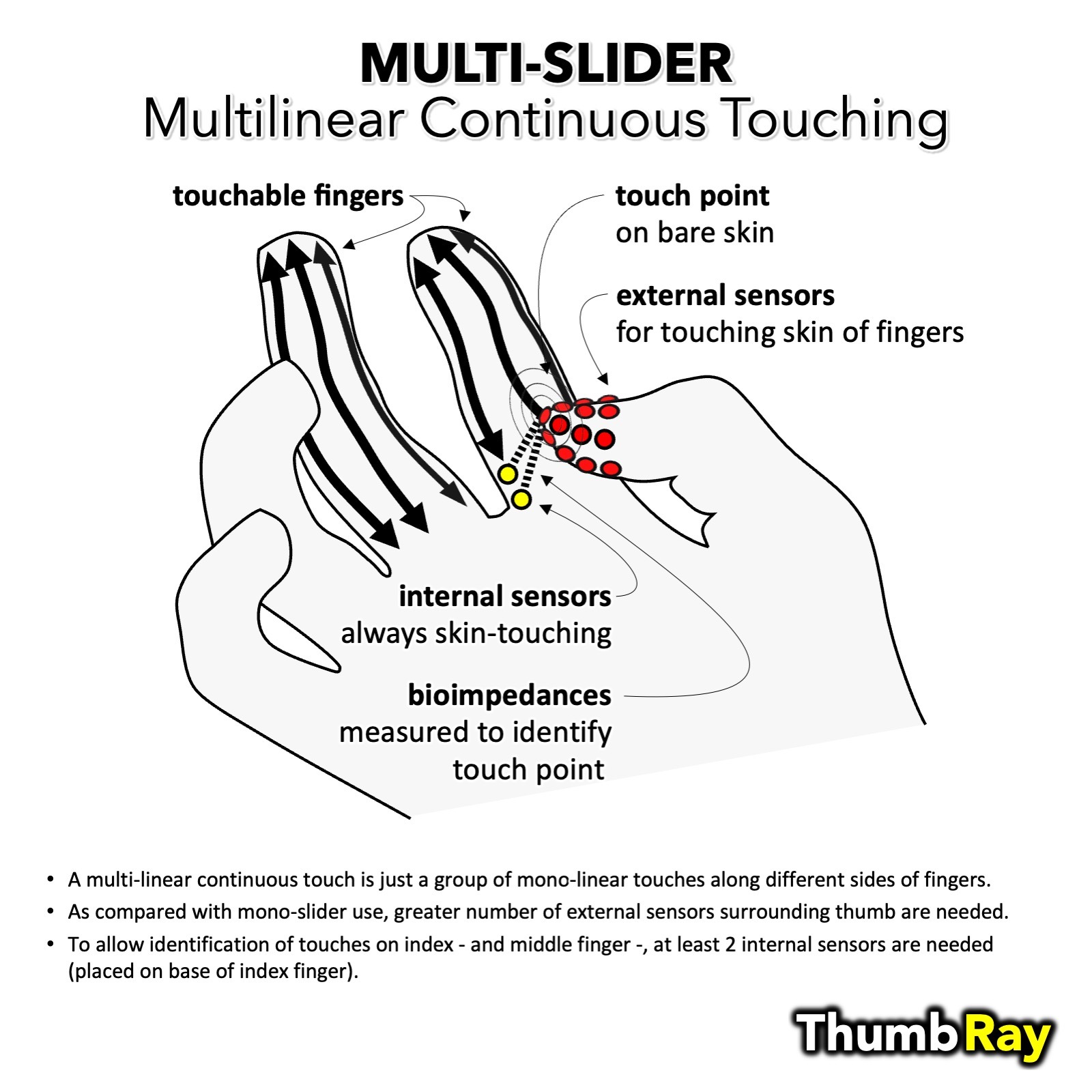
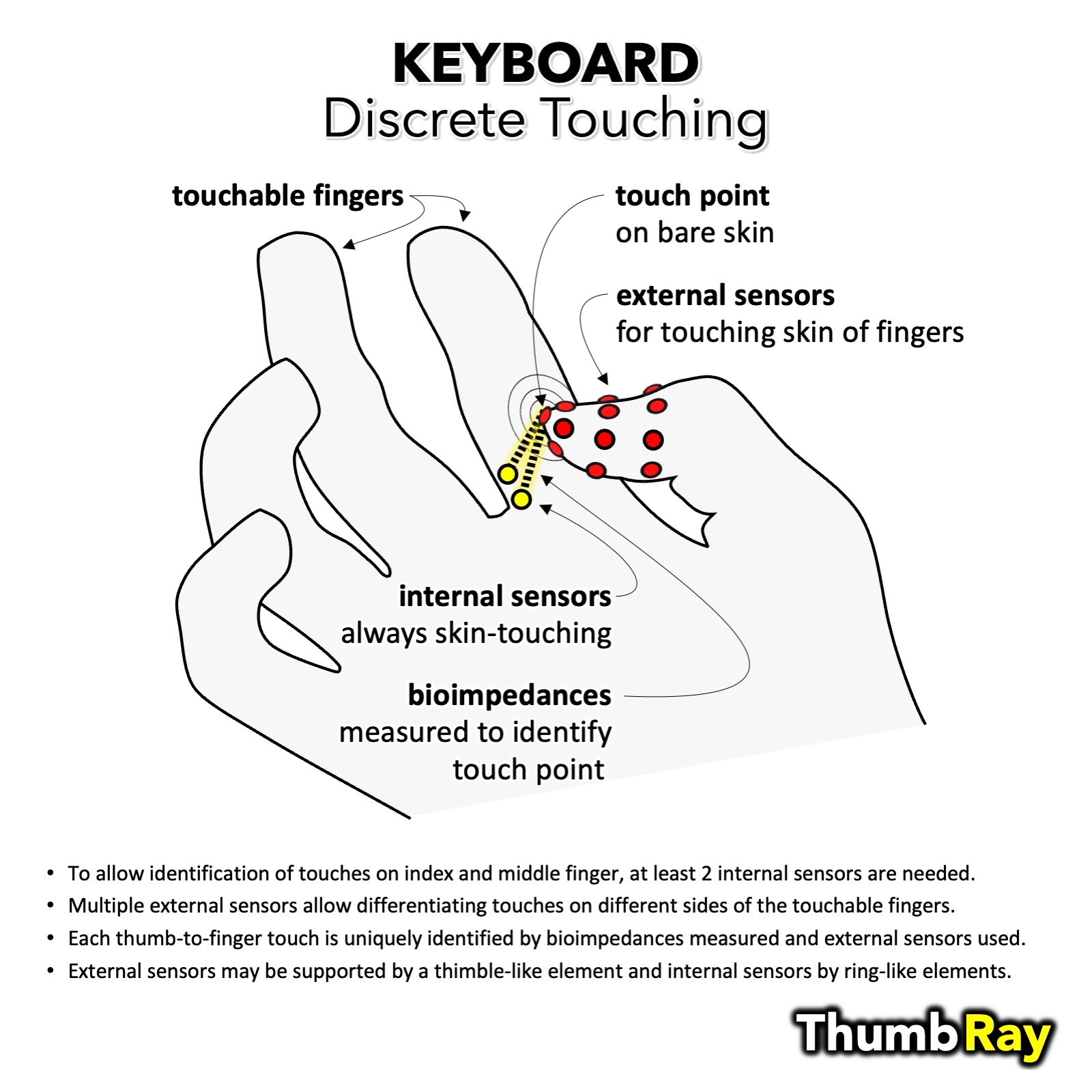
A one-hand worn eyes-free haptic data-input device detecting thumb-to-finger gestures via skin-touching electromagnetic sensing.
The technology is protected with a worldwide family of granted patents.
  Potential


  • become a universal standard for one-handed eyes-free input devices used in mobile scenarios
  • turn into the ultimate gadget in Wearable Electronics 

  Advantages


  • fully frees 1 hand
  • allows eyes-free use
  • preserves natural haptic feedback of palm and fingertips (worn only on thumb tip, base of several fingers and part of the wrist)
  • accepts discrete and continuous inputs (text, commands, pointing..)
  • replaces keyboard, mouse and keypad (by a much smaller wearable device)
  • suppresses need for onscreen keyboards (those that pop up on mobile phone screens)
  • worn and carried with comfort (key elements are just a thimble and 1-4 rings)
  • multi-functional (keyboard, pointer, biometric authenticator..)

  Target industries


The ThumbRay® invention may attract any firms that design, manufacture or commercialize interfacing devices between humans and computers, e.g. companies in the industries of technological consumer goods such as:

  •  Computers and Laptops

  •    Mobile phones and Tablets

  •    Peripherals

  Applications


ThumbRay® can integrate, in one single device, different functionalities:

  • entering of alphanumeric characters or commands (as with a keyboard or a keypad),
  • entering of pointing data (as with a mouse, a trackball, a touchpad or a joystick), or
  • user authentication via biometrics

Hence, it can be used in any applications where humans transmit alphanumeric, pointing, commanding or hand-based biometric data to electronic or computing devices. 

IP Infringement Warning

⚠️ ANY MAKING, USING, OR SELLING OF A WEARABLE DEVICE
THAT EMPLOYS SKIN-TOUCHING ELECTROMAGNETIC SENSING TO DETECT GESTURES
COULD BE AN ACT OF INFRINGEMENT
OF ONE OR MORE PATENTS OF THE THUMBRAY PATENT FAMILY.

Please contact us if you become aware of any possible violations.

THE PATENTS


 Patent Family


ThumbRay® IP comprises a positive PCT, a granted European Patent, and multiple national patents, a majority of them granted.

Property & Authorship


Key owners of  the invention’s Intellectual Property are ThumbRay Technologies SL and inventor Mr. Sáenz Löbsack.

Patent Drawings


Patent Excerpts


Abstract
The present invention relates to a single-hand wearable device to input different sorts of data into electronic appliances or computing devices, fundamentally by means of interpreting, via capacitive sensing or direct electrical-current detection, different discrete or continuous touch, approximation or pressure actions that take place between the thumb instrumented with parts of the claimed device and, either the skin or nails of the rest of the fingers of the same hand, or other parts of the claimed device worn on the fingers and/or on the interdigital areas of the same hand.
Potential of the invention
The device could potentially replace/integrate a considerable number of current input interfacing devices (keyboards, mouse, keypads, touchscreens, etc.) and provide miscellaneous significant benefits such as: improved wearability and portability (ease of use, minimal volume, compactness…), wide richness of inputs, freedom of one-hand and eyes-free interactions (suitability for sight-limited and one-handed users), non-affection by occlusions or light conditions, instrumental simplification (integration of different interfacing devices into a single one, potential elimination of on-screen keyboards), unique user customization (use as biometrical personal security access system), etc.
Prior Art (patents)

Some new wearable data-input solutions have attempted to overcome the drawbacks of current complex and cumbersome widely-used data interfacing devices like keyboards, mice and touchscreens; however, they have succeeded only partially, insufficiently or, in practice, inconveniently. As a matter of fact, a majority of those new solutions imply some new disadvantages such as those related to annulment of bear-skin tactile capacities, wearing discomfort, sense of bulkiness, complexity of use, operating limitations (e.g. affection by occlusions), poor richness of interaction (e.g. limited range of chords), unreliability of readings, restrictions in environmental factors, or dependence of additional external elements. Following there are some examples of those unsuccessful or only partially successful inventions:

  • US20120139708 discloses a one- or two-hands device to track finger and hand gestures fundamentally based on RFID technology, wherein signals transmitted are in a range of 700-1000MHz, wherein signal receiving units are passive RFID tags which are attached via rings or stripes to the distal segments of the fingers, and wherein the signal transmitting unit is an RFID reader attached to other parts of the body via garments such as a belt or a sleeve.
  • WO2009024971 discloses a one-finger ring-type user-input device fundamentally based on mechanical sensing technology, wherein user actions and gestures are identified via mechanical sensing of relative rotations and positions between stationary and rotatable sections comprised within the device.
  • US2011187637 discloses a one-hand tactile input device fundamentally based on capacitive sensing technology, wherein signal transmitting units are on fingers 2-5 and wherein signal receiving units are also on fingers 2-5 and are tactile capacitance sensors attached to ring-shaped elements worn on distal segments of the fingers.
  • US7109970B1 discloses a data-input device using a combination of voice commands and finger movements, using a plurality of finger-shaped sleeves that have embedded at least one contact-sensitive element and a microphone, wherein all receiving units of the contact-sensitive elements are exterior.
  • US6380923B1 discloses a wearable data-input device fundamentally based on shock sensing technology, wherein user actions are executed via strikes of the fingers on a physical surface, and wherein sensors are shock sensors such as accelerometers and are supported on ring-shaped elements worn on all fingers.
  • US20120319940 discloses a two-hands multi-finger data-input device fundamentally based on acceleration sensing technology, wherein sensors are attached to ring-shaped elements wearable on the proximal segments of the fingers.
  • US8743052B1 and US20150185852A1 disclose ring-type thumb-worn data-input devices fundamentally based on acceleration sensing technology (not on capacitive sensing technology), wherein the main sensor is just one accelerometer attached to the user’s thumb.
  • US20100156783 discloses a one-hand data-input device supported by a partial hand-covering garment which is fundamentally based on surface-contact sensing technology. Similarly, US7839383B2 discloses a partial-glove type device that does not cover all fingers. 
  • US20040263473 discloses a one-hand data-input device which detects motions fundamentally by means of photography and image-recognition technology, wherein the device comprises a bracelet with a camera and finger-worn ring-shaped elements including motion sensors.
  • US20070132722 and US6141643A disclose one-hand data-input devices that are fully embedded within a glove-type garment covering the whole hand.

Prior Art (publications)

Many novel hand-based systems to input data, based or not on the mentioned patents, have also been presented through a variety of scientific publications. However, none of them has proved to be a solid, comfortable and non-occlusive one-hand-wearable data-input solution. Following there are some examples of those disclosures and their basic drawbacks:

  • ‘SkinTrack’, ‘Abracadabra’, ‘SkinPut’, ‘iSkin’, ‘Omnitouch’ and ‘HoverFlow’ are conceived not for one, but for two hands;
  • ‘Kitty’, ‘DigiTouch’ and ‘FJG Wearable Keypad’ are one-hand wearables but based on a glove that occludes the majority of the skin of the hand;
  • ‘LightRing’, ‘SmartFinger’, ‘CyclopsRing’, ‘PickRing’, ‘PinchWatch’, ‘FingerInput’ and ‘TypingRing’ are one-hand/wrist not glove-based wearables, but quite limited in their functionality due to using only one ring or wrist band and/or due to being fundamentally based on sensing of user’s input gestures via infrared proximity/depth sensors, cameras, gyroscopes or accelerometers, and/or due to needing additional elements such as external surfaces or not hand/wrist-worn components.

Prior Art (conclusion)
In contrast with the referred state of the art, by means of the hereby presented invention, it should be possible to overcome not only many of the general drawbacks of current widely-used interfacing systems, but also many of the disadvantages associated to new state-of-the-art wearable data-input systems and methods. Furthermore, this invention could potentially imply a revolutionary technological contribution of value to thousands of millions of users as it could significantly improve the simplicity, speed, and freedom of maneuverability with which those users interact with their personal electronic devices on a daily basis.

About patents in general


What does a granted patent certify?
A granted patent certifies the patented invention to be:

  • patentable,
  • novel,
  • non-obvious,
  • industrially applicable, and
  • useful to society.
What are the requirements for a patent to be granted?
For a patent to be granted, the invention specified in the application must strictly meet the requirements of:

  • patentable subject-matter (must present concrete and technical character, in any field of technology),
  • novelty (must have never been used or published anywhere in the world, must not be part of the “state of the art”),
  • inventive step / non-obviousness (must imply substantial technical advance compared to existing knowledge, must not be obvious to a person skilled in the art), and
  • usability / industrial applicability (must have practical utility in an industry).
What rights derive from owning a patent?
A patent is an exclusive intellectual property asset that gives its owner:

  • legal rights to exclude others from making, using, distributing, selling, offering to sell, importing or exporting any products based on the patented invention,
  • within a geographical scope (usually the jurisdiction of the patent-issuing country),
  • for a limited period of time (usually 20 years from filling),
  • in exchange for enabling public disclosure of the invention.

A patent is a very strong and valuable weapon of litigation.

What control over the market gives you a patent?
Owning a valid patent is in theory equivalent to posessing full legal rights over a market monopoly, this is, having theoretical full legal operational and commercial control on any products that fall within the descriptive scope of the patented invention, inside a concrete territory and during a specific period of time.

THUMBRAY TECHNOLOGIES


a Deep Tech startup, built around the Skin-touching EM-Sensing Data-input Wearable, a high-tech microelectronics invention

[/su_list]

Parenting Company


Taurum Technologies provides support in the creation, funding, and managing of diverse entrepreneurial projects to deliver patented innovations.

REACT


License

Exploitation rights on our intellectual property assets, be them full or partial rights, and be them on patents granted, patents pending of grant, or rights to patent, could be available for purchasing via a specific licensing agreement. Given the vast geographical reach and wide scope of applicability of our patents, we are open to option agreements and licensing demarcations on industry, usage, exclusivity, and type of rights.

Purchase

Some of our IP assets, be them national patents granted, patents pending of grant, rights to patent, or trademarks, could be available for straightforward full sale and official public reassignment of the IP rights ownership. If your interest is in a patent still pending of grant, we are also open to option sale-purchase agreements, conditioned to the successful granting of the patent.

Invest

If you are an investor willing to believe in the economic and business potential of this innovation venture, please contact us to place preliminary enquires or to coordinate an exploratory conversation.

Kindly note that status of maturity, licensing and ownership of IP is subject to change.

Please, email to:

  • buy@taurum.com, if interested in licensing or outright purchasing our technology;
  • invest@taurum.com, if interested in purchasing our patents;
  • info@thumbray.tech for general enquiries.

You may also contact us via LinkedIn.

Contact

General enquiries:   info@thumbray.tech
Founder/inventor:   dsl@thumbray.tech
Investor relations:   invest@taurum.com

Connect

Founder/inventor:   danielsaenzlobsack
Privacy & Cookies: This site uses cookies. By continuing to use this website, you agree to their use.
To find out more, including how to control cookies, see here: Cookie Policy

Feel


True Innovation

© 2026 Taurum Technologies SL, all rights reserved

  •  The Invention
  •  The Patents 
    ▲
    • · Patent Family
    • · Ownership
    • · Drawings
    • · Excerpts
    • · About patents
  •  The Company 
    ▲
    • · Talent Force
    • · Advisory Board
  •  React
 

Loading Comments...